Cortona

Abbazia di Farneta & Le Celle

Cortona Cortona sights Cortona accommodations Farneta & Le Celle Frances Mayes Private Tours Cortona map

Benedictine Abbazia di Farneta (Abbey of Farneta)
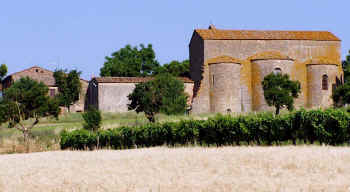
Abbazia di Farneta Cortona

Sights near Cortona Things to see near Cortona

The Farneta Abbey is situated at an altitude of 317 m. in the Chiucio hills of the Valdichiana, on the road between Cortona and Foiano. It is an ancient abbey, founded by the Benedettini Neri (Benedictine) monks on the site of a Roman temple in commendam to the Cortonese Cardinal, Silvio Passerini, the Bishops Ricci and Vagnucci and to the Ligurian, Dei Carretto. It was then passed on to the Benedettini olivetani monks, who kept it until the suppression of the Grand Duke Pietro Leopoldo di Lorena, around 1780, when the secular priests (Diocese of Cortona) took over from them. 
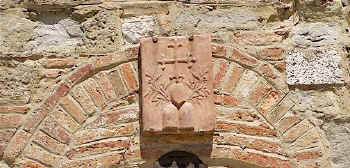
Farneta Abbey portal

The unusual architectural features of the structure were mainly publicised from 1937 onwards, thanks to the efforts of Don Sante Felici, parish abbot of Farneta. The crypt, which was uncovered and restored through the efforts of Don Sante, is made up of three cela with barrel and cross vaults, supported by various columns of Roman origin. The first column, rose-coloured granite, comes from Assuan in southern Egypt and has Roman capitals with various figures carved on it, amongst which there is achelňo (a human figure with horns). In the centre there is a kind "tempietto" with four columns, two of oriental marble, one of Ionic travertine (with 16 flutes) and the other of ash-coloured oriental granite. The Roman funerary stele, between the central and northwest cells, is also interesting and bears the inscription "Quartafiglia di Erennio Pompeo Liberto". The column of the third cell, a classic travertine base, like the first, is made of oriental marble and has a sandstone, cube-shaped capital, and is engraved on the four sides with a cross and flowers. One of the bells was re-cast in 1724, and the other, by Mugnai Filippo di Montevarchi, dates from 1827. 

A Museum known as the "antiquarium" adjoins the church and houses palaeontological and archaeological exhibits.

Franciscan Santuario Le Celle (Hermitage of Le Celle)

Santuario Le Celle (Hermitage of Le Celle)

The friars' garden at Le Celle

The friars' garden at Le Celle

St Francis' cell at Le Celle

La Cella di San Francesco

The Cella di San Francesco is believed to be the place where, in May 1226, four months before his death in Assisi, St Francis dictated his Will. Following his death, in October of the same year, Brother Elia withdrew permanently to the Le Celle hermitage in 1239 and carried out a number of improvements. The walls built under Brother Elia are rough but solid, and the hermitage contains eight small rooms large enough for a bed, a table and a chair – the essential furnishings prescribed by St Francis himself for a Franciscan hermitage, where the prime importance was to lead a life given over to contemplation. After Brother Elia’s death in Cortona in 1253, the Franciscan order fell into a complicated series of internal divisions. The hermitage was occupied by a community of "Spirituali", or "Fraticelli", until they were banished in 1363 after suffering excomunication from Pope John XXII. Le Celle stood abandoned until 1537, when it was granted by the Bishop of Cortona to the recdently founded Third Order of Franciscans, known as the Capucins. The hermitage was considerably enlarged by the Capucins, who in 1634 erected a new chapel to take the place of the ancient chapel dedicated to St Michael. This new chapel was consecrated to St Anthony of Padua and reflects the simple, unpretentious architectural and decorative style of the Capucins. Unadorned by works of art, the chapel still has wooden altars.

Currently the hermitage is inhabited by seven Franciscan friars.

Accommodation: The convent is able to offer lodgings to those contemplating a vocational life and who are willing to take part in all of the community’s activities. Near the convent there are some 40 bed spaces available in houses for independent groups of visitors.
Spiritual retreat: Le Celle is able to offer a period of solitary prayer to priests for a minimum period of one week and lasting up to a month if necessary. This facility is available in a small hermitage above the convent itself.


Back to Cortona

Cortona © ammonet InfoTech 1998 - 2009. All rights reserved.